
 EN

V Blender vs Hopper Mixer for Dry Powder Mixing
Choosing between a V blender and a hopper mixer is less about naming a “better” machine and more about matching the mixer to the powder, the batch workflow, and the transfer path. For pharmaceutical dry-powder operations, the decision affects not only blend uniformity but also cleaning, containment, traceability, and the time required to move a batch from one unit operation to the next.
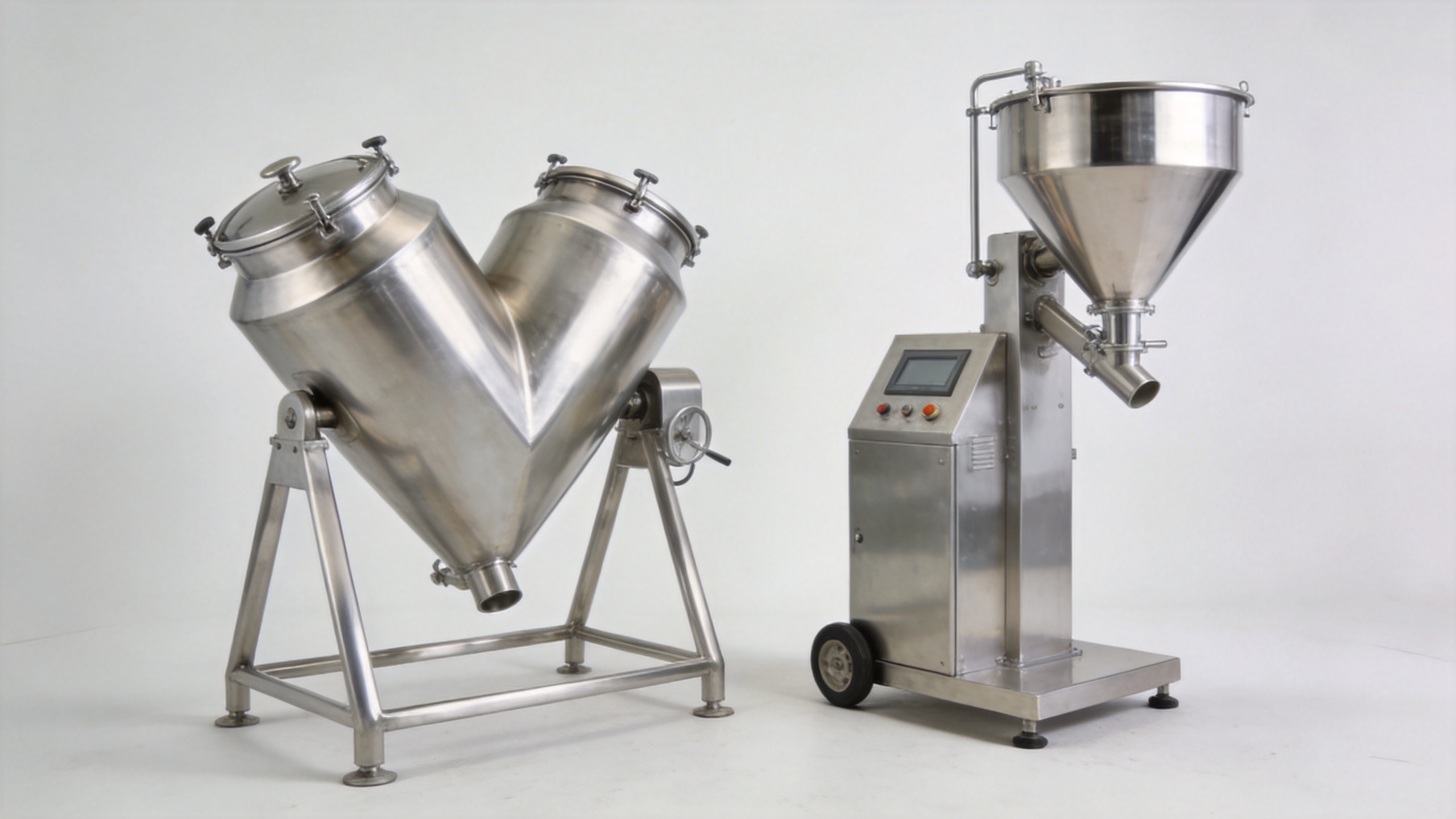
A v blender dry powder mixer uses a fixed V-shaped vessel and gentle tumbling to divide and recombine powders as the shell rotates. A hopper mixer—often called a bin blender or IBC blender—mixes material inside a removable hopper that can also serve as the transport container. Both can be appropriate for free-flowing powders and granules. The practical difference is where the product lives before, during, and after blending.
Start With the Process Flow, Not the Mixer Name
Before comparing equipment, map the route from dispensing to final discharge. Ask where the material is charged, how it reaches the blender, whether it must be transferred after mixing, and which steps require closed handling. This exercise often clarifies the choice faster than comparing a list of motor ratings.
A V blender typically receives material into its own vessel, blends it, and then discharges into the next container or process. That can be a simple, effective arrangement when batch movement is straightforward and the formulation changes infrequently. A hopper mixer keeps the batch in the same bin through blending and subsequent movement, which can reduce intermediate handling where the process is designed around portable containers.
More precisely, the important question is not whether one design has fewer steps on paper. It is whether the actual charging, docking, lifting, discharge, and cleaning sequence fits the site's layout and its approved operating procedures.
How the Mixing Mechanisms Differ
A v blender dry powder mixer relies on gentle tumbling. As the V shell turns, the powder bed repeatedly separates into two legs and recombines near the junction. This makes the design a familiar option for dry powders and granules that should not be exposed to aggressive mechanical action. Its suitability still depends on material behavior: particle-size distribution, density differences, moisture sensitivity, static charge, and the required degree of uniformity all need evaluation at the intended fill level.
A hopper mixer also uses rotation or controlled movement, but the material remains inside the process hopper. The mixing action and the hopper geometry should be assessed as a system. For some production lines, the hopper's ability to move between stations is the central advantage; for others, a fixed blending vessel is easier to integrate. Neither arrangement removes the need for development trials and blend-uniformity verification.
Batch Changeover and Cleaning: Where the Real Trade-Off Appears
For a v blender dry powder mixer, changeover planning usually focuses on access to the vessel, discharge valve, seals, and any intensifier bar or auxiliary component. A simple configuration may be attractive where cleaning access and inspection are priorities. However, the full changeover time includes the upstream and downstream containers used to handle the batch—not only the blender itself.
With a hopper mixer, the bin becomes a process-contact item that must be available, cleaned, inspected, and scheduled. This can support orderly batch flow when multiple compatible hoppers circulate through a line. It can also introduce planning pressure if hopper availability, lift interfaces, or storage space are limited. The right evaluation is therefore a site-specific time study: count every transfer, connection, cleaning activity, and release check.
Do not assume that a removable hopper automatically means faster changeover, or that a fixed V shell automatically means simpler cleaning. The outcome depends on the equipment configuration and validated cleaning approach.
Material Transfer and Containment Considerations
Material transfer is a major selection criterion for dry-powder plants. Each open transfer can create opportunities for dust exposure, segregation, loss, or operator intervention. If the process benefits from keeping a batch enclosed from blending through transfer, a hopper-based arrangement may deserve close review. If the line already uses controlled charging and discharge methods around a dedicated mixer, a V blender can remain a sound, economical process choice.
Containment requirements should be reviewed with the formulation's hazard assessment, charging method, local extraction strategy, and cleaning procedure. Equipment geometry alone does not establish containment performance. Likewise, a v blender dry powder mixer should be judged by the complete system around it, including seals, interfaces, sampling practice, and discharge controls.
A Practical Comparison for Dry Powder Selection
| Decision area | V blender | Hopper mixer |
|---|---|---|
| Product location | Material is blended in the fixed V vessel. | Material is blended in a removable hopper or bin. |
| Typical strength | Gentle tumbling for suitable dry powders and granules. | Combines blending with a container-based transfer workflow. |
| Transfer planning | Requires a defined discharge and downstream transfer route. | Can keep the batch in the same hopper between compatible stations. |
| Changeover focus | Vessel, valve, seals, and connected handling equipment. | Hopper fleet, docking interfaces, cleaning, inspection, and logistics. |
| Evaluation method | Trial at intended fill level with representative material. | Trial that evaluates both blend quality and the complete bin-handling sequence. |
When a V Blender Is Often the Better Fit
A v blender dry powder mixer is often worth prioritizing when the product is free-flowing, gentle tumbling is appropriate, and the manufacturing route does not require the blending vessel to serve as the main transport container. It can be particularly practical for straightforward batch processing where operators can charge and discharge through a well-defined system and where the cleaning strategy is easy to inspect and validate.
It may be less suitable when the formulation segregates easily during transfer, when the process requires a container-based closed route between several stations, or when the material needs an action that simple tumbling cannot provide. Those conditions should trigger process trials rather than a quick design assumption.
When a Hopper Mixer Is Often the Better Fit
A hopper mixer can be a strong option when batch mobility is part of the production design. The same container can support staging, blending, movement, and discharge through compatible interfaces, helping the team focus on a more continuous material path. This approach is especially relevant when reducing manual handling or coordinating multiple solid-dose processing steps is a priority.
For teams evaluating this route, the AUTOMATIC LIFTING HOPPER MIXER is a product category to review against the actual hopper size, lift path, docking arrangement, and validated process requirements. Confirm the technical configuration directly with the supplier; the product name alone does not establish suitability for a particular formulation.
Use a Trial Plan to Make the Final Decision
For either design, a sound selection process should define the material attributes to test, the intended batch fill range, the charging order, the target mixing time window, sampling locations, and the post-blend transfer route. Include a realistic changeover scenario rather than evaluating only an empty-machine demonstration. If the powder contains components with different densities or particle sizes, test the worst credible conditions for segregation and sampling variability.
In short, select a v blender dry powder mixer when gentle fixed-vessel blending aligns with the batch route. Select a hopper mixer when the container itself should play an active role in material movement. The better choice is the one that gives your team a controllable, verifiable process from charging through discharge—not simply the mixer with the most appealing feature list.
V Blender Evaluation Checklist
Use this short checklist before selecting a v blender dry powder mixer for a new or revised process:
- Confirm that the material is intended for gentle tumbling and identify any risk of segregation during charging or discharge.
- Run a representative trial at the planned fill level; a v blender dry powder mixer should be assessed with the actual component ratios, not only a single-component test.
- Define the complete route after blending, including discharge container, transfer distance, sampling points, and hold-time controls.
- Review access to the shell, valve, seals, and ancillary components with the proposed cleaning and inspection procedure.
- Document acceptance criteria for blend uniformity and compare the results with the operational needs of the downstream process.
This checklist does not replace development or validation work. It gives procurement, engineering, and production teams a shared way to decide whether a v blender dry powder mixer supports the intended batch flow.
Questions to Ask a Supplier
Ask for information that connects equipment to your material and workflow: operating fill range, charging and discharge arrangements, cleaning access, material-contact details, controls, and trial support. For hopper systems, also review hopper fleet, lift travel, docking interfaces, storage, and station compatibility.
Share a process sketch, batch size, material description, and preliminary sampling plan so the supplier discussion becomes a realistic system evaluation rather than a general specification review.