
 EN

Powder Mixer vs Powder Blender: How to Understand the Terms
If you are sourcing equipment for dry ingredients, the phrase powder mixer blender can be confusing. Catalogs, RFQs, and production teams often use “mixer” and “blender” for the same machine, yet the words can also suggest different process duties. The practical question is not which label sounds more technical. It is whether a powder mixer blender will move, distribute, and discharge your material in a way that fits the batch and the process.
For pharmaceutical, food, chemical, and fine-material buyers, this distinction matters because a name alone does not confirm blend uniformity, shear level, cleanability, or how the machine handles segregation. This article gives a plain-language framework for reading powder mixer blender terminology before you start comparing designs.
Why the Terms Overlap
In industrial use, a powder mixer blender usually refers to equipment that combines dry powders, granules, or small quantities of added ingredients into a more uniform batch. “Mixer” is a broad term. It can describe a vessel with moving tools, a tumbling container, or a higher-energy process. “Blender” often emphasizes gentle bulk movement and distribution, especially when free-flowing powders or granules are involved.
That is why one supplier may describe a V-shaped vessel as a powder blender, while another calls a similar unit a dry powder mixer. Neither label, by itself, tells the whole story. A buyer should treat powder mixer blender as a starting category, then ask what movement pattern the machine creates and what the formulation needs.
Dry blending means combining powdered or granular ingredients without a liquid phase to obtain a more uniform mixture. In solid-dose manufacturing, that task can affect how consistently ingredients are distributed before later steps. The same basic goal appears in food premixes, chemicals, plastics, and other bulk-material operations, although the material risks and validation requirements differ.
Mixer, Blender, and Agitator: A Useful Working Distinction
| Term | Common working meaning | Questions to ask |
|---|---|---|
| Powder mixer | A broad label for equipment that combines powders through tumbling, paddles, ribbons, screws, or other motion. | What is the shear level? Does the motion break agglomerates or simply redistribute material? |
| Powder blender | Often used for relatively gentle batch blending, particularly with free-flowing powders or granules. | How is segregation controlled during filling, blending, and discharge? |
| Agitator or high-shear mixer | Usually indicates more active local mixing or particle interaction. | Is the energy appropriate for cohesive powders, additions, or deagglomeration? |
These are working distinctions, not universal rules. A powder mixer blender should therefore be compared by design and test conditions rather than by a product-page heading. The right terminology for your internal specification is the terminology that states the required result: homogeneous distribution, gentle handling, controlled shear, or another measurable process objective.
Machine Geometry Explains More Than the Name
When reviewing a powder mixer blender, start with how material moves. Tumble blenders use vessel rotation and gravity to repeatedly divide and recombine a batch. They are commonly considered for free-flowing powders and granules when gentle handling is important. A V blender is one example: its V-shaped chamber encourages the material to split and rejoin during rotation.
Ribbon, paddle, plough, or screw designs use internal tools to move material through the vessel. Depending on the design and operating settings, they may provide more active mixing than a tumbling system. A powder mixer blender with internal tools may be considered when powders are cohesive, when small additions must be distributed carefully, or when the process needs a different balance of circulation and shear. That does not automatically make it better; more energy can be unsuitable for fragile particles or formulations that segregate after mixing.
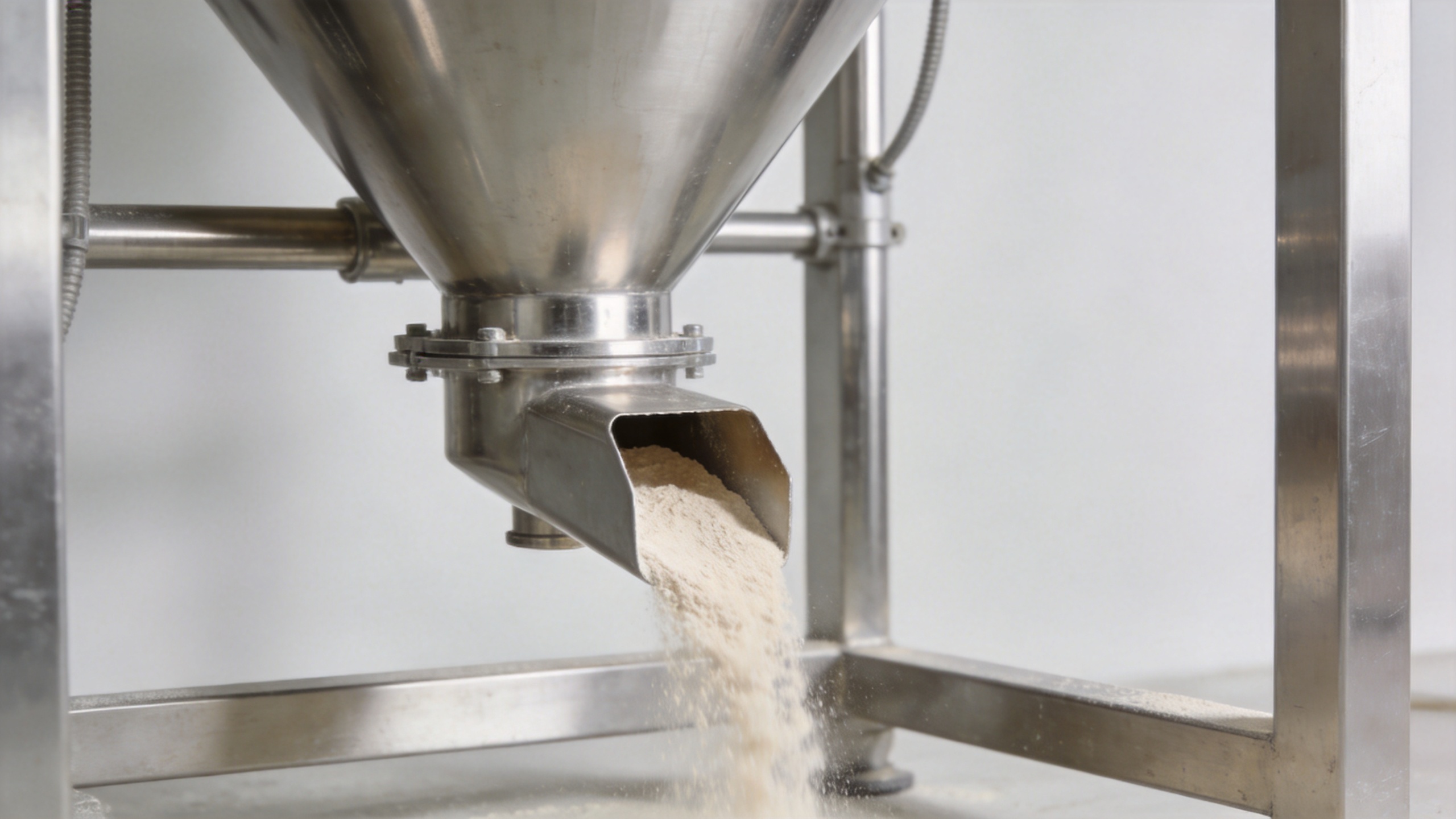
For a batch workflow that includes contained transfer, a lifting hopper concept may also be relevant. You can review the automatic lifting hopper mixer as an example of a real site product category to discuss with a supplier. The product link confirms the category only; final suitability still depends on your material and process review.
Choose by Material Behavior, Not by Search Vocabulary
A good powder mixer blender selection begins with a material brief. Record particle-size distribution, bulk density, moisture sensitivity, flow behavior, electrostatic tendency, friability, and the proportion of minor ingredients. Two powders with similar names can behave very differently in a vessel.
- Free-flowing powders and granules: A gentle powder mixer blender may be appropriate, but confirm that the batch will not segregate during discharge.
- Cohesive or poorly flowing powders: Ask how the powder mixer blender promotes circulation and whether the process needs controlled deagglomeration.
- Fragile particles: Check whether mixing action, fill level, and run time could cause attrition.
- Low-dose additions: Define sampling locations and acceptance criteria before assuming a powder mixer blender can achieve the required distribution.
For pharmaceutical operations, the discussion should also cover cleaning approach, containment, traceability, and validation strategy. A machine label cannot replace process development or a documented uniformity study.
A Buyer Checklist for RFQs and Supplier Discussions
Instead of asking only for a “powder blender” or a “powder mixer,” give suppliers a concise, comparable brief. This makes the powder mixer blender conversation more useful and reduces the chance of receiving proposals for machines built around different assumptions.
- Describe every material, including density, particle size, moisture limits, and any safety or containment considerations.
- State the target batch size and acceptable operating range; a powder mixer blender should be evaluated at realistic fill levels.
- Define the objective: gentle blending, deagglomeration, distribution of minor ingredients, or a combination.
- Explain upstream and downstream handling, especially charging, sampling, discharge, and transfer.
- Ask for the proposed motion principle, cleaning concept, controls, and the recommended trial method.
- Agree on how blend quality will be assessed rather than relying on mixing time alone.
The Bottom Line
In most industrial conversations, powder mixer blender is not a strict either-or choice. It is a useful umbrella phrase for dry-powder equipment whose exact meaning depends on machine geometry, material behavior, and the intended result. Use “mixer” and “blender” as prompts for better questions, not as proof of performance.
When you compare a powder mixer blender, prioritize the powder data, the flow pattern, the batch-handling sequence, and the verification plan. That approach gives purchasing and process teams a clearer foundation for selecting equipment that fits the actual operation.