 EN

Pneumatic Vacuum Conveyor vs Mechanical Feeding: Which Fits Your Process?
Choosing between a pneumatic vacuum conveyor and mechanical feeding is more than an equipment comparison. It is a process decision that affects containment, material flow, cleaning routines, line layout, and operator workload. For powder-handling teams in pharmaceutical and related solid-dose processes, the decision should start with the material and the handoff points—not a generic capacity claim.
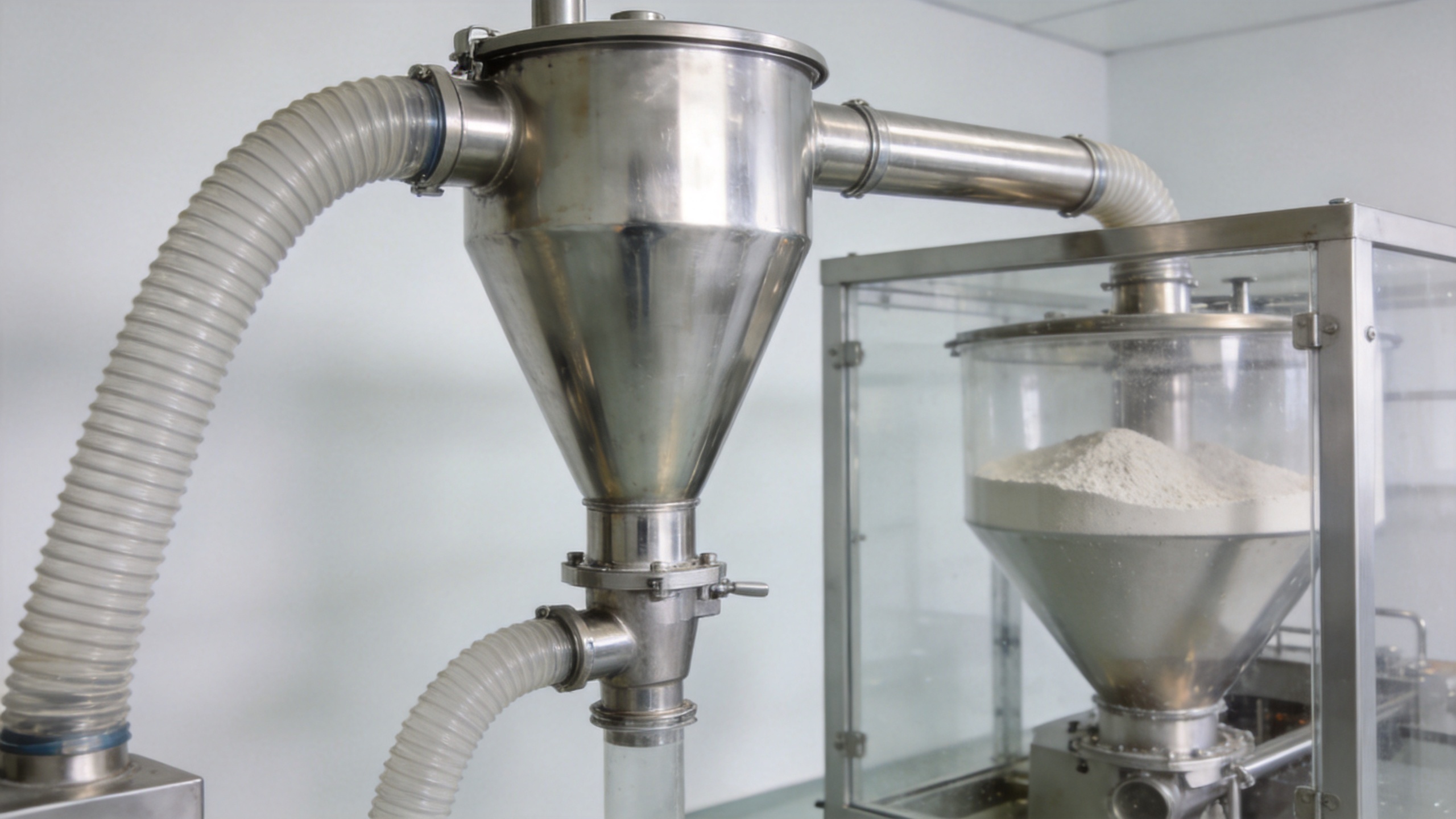
A pneumatic vacuum conveyor uses a pressure difference to move powders, granules, and other dry bulk solids through a closed route. Mechanical feeders, such as screw-based systems, use moving hardware to push or lift material. Both can be valuable. The right fit depends on what the process needs to protect, how the material behaves, and how the equipment must connect with upstream and downstream steps.
Start With the Process Risk You Need to Control
In a pneumatic vacuum conveyor system, the transfer path can be enclosed from pickup point to receiver. That makes a pneumatic vacuum conveyor worth evaluating when dust exposure, product containment, or separation between process rooms is a central concern. A closed route can also simplify connections from a bag-dump station, bin, or hopper to a mixer, mill, or tablet-processing step. It does not automatically make a system compliant or cleanable; seals, filters, receiver geometry, cleaning access, and validation still need to match the process.
Mechanical feeding may be the more direct option when the route is short, open access is acceptable, and the material is easy to meter with a screw or similar device. It can be especially practical where the line already has a stable feed point and the primary goal is controlled delivery rather than routing material around obstacles. The important distinction is that containment must be designed into either approach, rather than assumed from the equipment name.
Compare Material Behavior Before You Compare Equipment Sizes
Material behavior should lead the selection. Free-flowing powders and granules may be suitable for either system, but cohesive, fragile, abrasive, moisture-sensitive, or segregation-prone materials need a closer review. A pneumatic vacuum conveyor can offer a flexible route for many dry materials, yet air velocity, pickup design, filter loading, and discharge timing can affect how a formulation moves. Dense or plug-flow approaches may be considered for materials that require more controlled handling, but the configuration must be verified with representative product.
Mechanical feeding gives engineers a different set of controls: screw geometry, speed, pitch, and hopper design can be tailored for a particular flow pattern. At the same time, product contact with moving parts can create concerns about buildup, wear, or cleaning effort. Do not choose based on a nominal throughput alone. Test the real bulk density, particle-size distribution, moisture condition, flowability, and allowable breakage range.
Where Each Method Commonly Fits
| Decision factor | Pneumatic vacuum conveyor | Mechanical feeding |
|---|---|---|
| Route layout | Useful when material must travel through enclosed pipework or around line constraints. | Often simplest for a direct, short, largely linear route. |
| Containment objective | Strong candidate when a closed transfer path is a priority. | Can be enclosed, but the design must address joints, drives, and access points. |
| Material sensitivity | Requires validation of air flow, filter behavior, and product movement. | Requires validation of shear, buildup, wear, and screw-to-material interaction. |
| Integration | Can connect storage, charging, mixing, and downstream equipment through a flexible route. | Works well where equipment elevations and feed locations are already fixed. |
| Maintenance focus | Review filters, seals, vacuum source, valves, and receiver cleaning. | Review screw, bearings, seals, drives, and cleaning access. |
For a pharmaceutical factory, the table is a screening tool—not a substitute for a material trial. The decision becomes clearer when the process owner identifies which compromise is less acceptable: a more involved vacuum and filtration system, or more direct mechanical contact and a constrained route.
Assess the Handoff Between Process Steps
The real comparison often happens at the interfaces. Ask how material enters the system, how it is received, and what equipment follows. A pneumatic vacuum conveyor can be a natural option when a powder needs to move from a container or charging point into a closed receiving vessel before mixing or processing. Mechanical feeding can be efficient when the machine sits close to the next step and continuous, predictable delivery is the priority.
Look beyond the feeder itself. Evaluate the hopper level signal, batch changeover, dust extraction connection, access for inspection, discharge valve arrangement, and the controls needed to prevent a downstream machine from being overfilled. These details shape uptime more than a simplified “vacuum versus screw” label.
Plan Maintenance and Cleaning as Part of the Investment
The maintenance burden changes rather than disappears. A pneumatic vacuum conveyor needs a preventive plan for filter condition, valve function, seals, vacuum generation, and the cleanliness of product-contact areas. A mechanical feeder needs regular attention to drive components, screws, bearings, wear surfaces, and residue accumulation. In both cases, the team should define who can access the equipment, what can be inspected without disassembly, and how often a changeover requires cleaning.
During specification, ask suppliers to walk through the planned cleaning sequence with your actual operating team. A system that looks compact in a layout may be costly to maintain if filters, screws, or contact parts are difficult to reach. Conversely, a thoughtfully configured system can support a repeatable maintenance routine even when the equipment architecture is more sophisticated.
Validate a Pneumatic Vacuum Conveyor With a Representative Trial
Before purchase approval, run the candidate pneumatic vacuum conveyor with representative material at the expected moisture range and batch condition. Record pickup stability, receiver fill time, filter behavior, discharge completeness, and any visible change in particle condition. Confirm how the pneumatic vacuum conveyor will respond to normal starts, stops, empty-source conditions, and planned cleaning.
Use the same discipline for a mechanical option. Comparing both systems under defined acceptance criteria gives the project team a more useful result than comparing catalogue capacities. The preferred system is the one that handles the real product safely and repeatably while fitting the full operating routine.
A Practical Selection Checklist
- Map the source, destination, transfer distance, and elevation changes.
- Classify the material by flowability, cohesiveness, fragility, dustiness, and sensitivity to moisture or segregation.
- Set containment and housekeeping objectives for normal operation, charging, and changeover.
- Define the required feed pattern: batch transfer, intermittent charging, or continuous metering.
- Review cleaning access, filter or screw maintenance, and spare-parts requirements with the people who will operate the line.
- Run a representative material test before locking in capacity, conveying mode, or component selection.
Choose the System That Solves the Actual Constraint
A pneumatic vacuum conveyor is often the better starting point when enclosed powder transfer, flexible routing, and integration between process steps matter most. Mechanical feeding can be the more straightforward fit when the route is short, the feed point is fixed, and the material responds well to controlled mechanical delivery. Many plants use both methods in different parts of the same operation.
If your team is evaluating a vacuum-fed connection for powder handling, the ELECTRIC VACUUM FEEDER ZKS is a relevant product category to review alongside your material trial and line-integration requirements. The final selection should be based on verified material behavior, process interfaces, and maintainability—not a one-size-fits-all comparison.