
 EN

Laboratory Mixer Selection Guide for Pharmaceutical Formulation Trials
Choosing a laboratory vortex mixer for pharmaceutical development begins with an important distinction: a compact vortex unit is designed mainly for small tubes and vials, while powder formulation trials may require a different laboratory mixing format. The right choice is the one that produces useful, documented process knowledge at the sample scale—not simply the one with the highest speed.
For formulation scientists, a laboratory mixer should support repeatable trials, practical cleaning, and a credible path to later development work. This guide helps teams compare sample quantity, mixing mechanism, powder behavior, and scale-up relevance before selecting equipment.
Start by defining what the trial must prove
Before comparing equipment, write down the decision the experiment must support. Is the study screening excipient compatibility, checking blend uniformity, dispersing a minor component, or establishing a preliminary operating window? Each question points to a different mixing action and test record.
ICH Q8(R2) frames pharmaceutical development around the relationship between material attributes, process parameters, and critical quality attributes (CQAs). In practice, that means a trial plan should identify what will be changed, what will be observed, and what result will signal an acceptable blend. The aim is not to declare a setting universally correct; it is to build evidence for the specific formulation.
- Material attributes: particle-size distribution, bulk density, flow behavior, moisture sensitivity, and segregation tendency.
- Process factors: fill level, mixing time, speed or intensity, vessel geometry, and loading sequence.
- Responses: visual distribution, assay or blend-uniformity results, agglomerate formation, yield, and cleanability observations.
Know where a laboratory vortex mixer fits—and where it does not
A laboratory vortex mixer can be useful when the work involves small liquid samples in tubes or vials, such as rapid dispersion checks or re-suspension work. Search results for this term commonly describe tube- and vial-scale equipment with touch or continuous operation. That makes the tool convenient for micro-scale liquid handling, but it should not be assumed to represent a powder-blending process.
For dry powder formulation trials, the central issue is usually controlled movement of a larger powder mass in a defined vessel. A vortex action can create localized circulation, whereas a tumbling, bin, or other batch-mixing approach may better reflect the material movement that matters for powder blend uniformity. The appropriate choice depends on the objective, not on the word “mixer” in the product name.
Match sample quantity and fill level to the mixing mechanism
Small development batches are valuable because they conserve active ingredients, but very small fills can also exaggerate wall effects, dead zones, or segregation. Select a vessel size that allows the formulation to move in the way the experiment is intended to study. Record both the actual charge weight and the working fill level for every run.
| Trial question | Useful selection focus | What to document |
|---|---|---|
| Rapid liquid dispersion in tubes or vials | Compact laboratory vortex mixer, compatible holders, controllable operating mode | Container type, sample volume, operating time, visible dispersion |
| Early dry-powder blend screening | Vessel geometry and movement that suit the powder mass and segregation risk | Charge weight, fill level, loading order, sampling plan |
| Scale-up-oriented formulation learning | Equipment principle with a documented rationale for process similarity | Mixing mechanism, time, intensity, material behavior, transfer assumptions |
Evaluate powder behavior before choosing speed
Speed alone is rarely a complete selection criterion. Cohesive powders may form agglomerates; free-flowing components may segregate; and low-dose ingredients may demand a careful premix strategy. Consider whether the selected equipment gives enough movement to distribute components without creating an unrepresentative level of shear or exposing the material to unnecessary stress.
A practical trial sequence is to hold most conditions constant and change one meaningful factor at a time during early screening. Once the team identifies likely critical factors, a planned design of experiments can examine interactions. For a mixing operation, ICH Q8(R2) notes that a design space may include shear rate rather than agitation alone—an important reminder to describe the physical action, not just an rpm value.
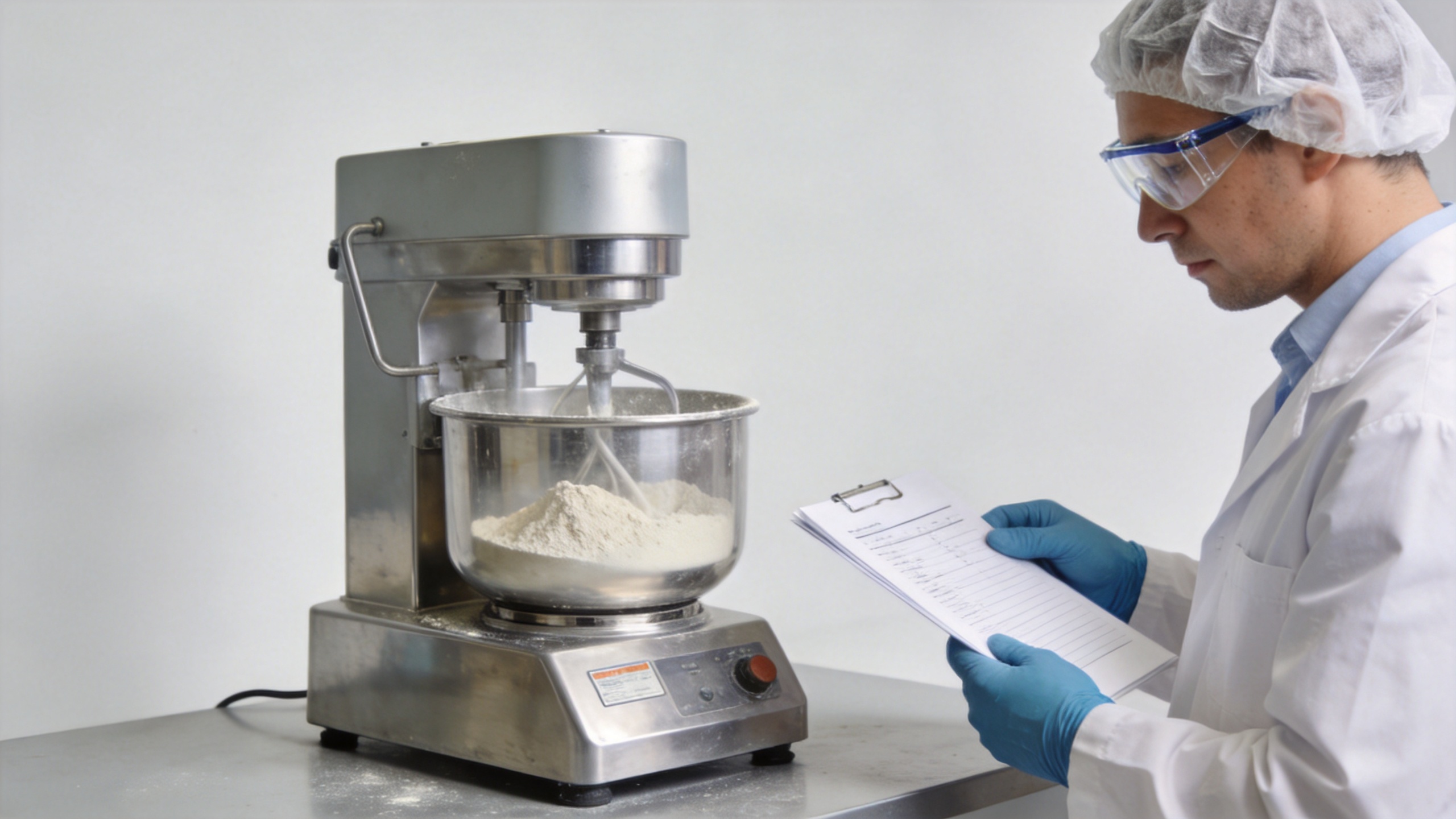
Build scale-up thinking into every laboratory run
FDA process-validation guidance describes a lifecycle that uses knowledge gained during development and scale-up activities. A laboratory study does not need to duplicate production scale, but it should create a traceable rationale for the next experiment. This is why records of vessel geometry, fill level, charging sequence, mixing duration, sampling locations, and observed material behavior are as important as the final result.
Ask suppliers how they describe the operating principle, available vessel configurations, material-contact options, and cleaning access. Then compare those answers with the trial protocol. For teams evaluating a laboratory-scale platform, the LABORATORY MIXER HSD can be reviewed alongside the formulation’s documented sample-size and process-learning requirements. Product selection should still be confirmed against the actual formulation, safety assessment, and validation strategy.
How to run a practical laboratory vortex mixer comparison
When a laboratory vortex mixer is part of the shortlist, use it in a controlled comparison rather than treating one fast result as conclusive. Run matched samples in the same container type, define the start and stop point, and record whether the task is dispersion, re-suspension, or simple homogenization. For vial-scale liquid work, the laboratory vortex mixer may be a practical and efficient tool; for a powder blend study, document why a different movement pattern is more representative.
A useful laboratory vortex mixer trial sheet includes sample identity, volume or charge weight, container geometry, operating mode, duration, visible result, and any temperature or foaming observation. This simple record lets scientists distinguish equipment suitability from an isolated favorable outcome. It also helps prevent a laboratory vortex mixer result from being inappropriately transferred to a larger powder process.
During supplier evaluation, ask whether the laboratory vortex mixer configuration supports the actual containers and workflow under consideration. Then keep the result in context: equipment fit should be assessed together with formulation behavior, sampling requirements, cleaning expectations, and the subsequent development step.
Use a decision checklist before ordering equipment
- Define the formulation question and the quality response to be measured.
- Classify the material as primarily liquid, free-flowing powder, cohesive powder, or a mixed system.
- Set the practical batch range and acceptable working fill level.
- Choose a mixing mechanism that represents the intended study, rather than relying on a generic equipment label.
- Specify the records needed for transfer: vessel details, sequence, time, intensity, samples, and observations.
- Review cleanability, containment, material compatibility, and site procedures with the responsible quality and EHS teams.
Conclusion: select for learning, not just for movement
A laboratory vortex mixer is a sensible choice when the experiment truly involves tube- or vial-scale liquid mixing. For pharmaceutical powder formulation trials, however, the better question is which laboratory mixing approach will generate representative, repeatable evidence for the next stage of development. By linking sample quantity, mixing mechanism, powder behavior, and documented process learning, formulation teams can make a more defensible equipment decision.