
 EN

How to Choose an Industrial Powder Mixer for Pharmaceutical Production
Choosing an industrial powder mixer for pharmaceutical production starts with the formulation, not with a catalogue capacity. The right industrial powder mixer should fit the batch range, powder behavior, cleaning strategy, and route to the next operation. For procurement teams, an industrial powder mixer is therefore a process decision as well as an equipment purchase.
In drug manufacturing, the selection of an industrial powder mixer should support intended use, cleaning, and maintenance. 21 CFR 211.63 states that equipment should have appropriate design, adequate size, and suitable location to facilitate operations, cleaning, and maintenance. That principle does not prescribe one industrial powder mixer design. It means the proposed machine should be assessed in its real production context.
Define What the Industrial Powder Mixer Must Accomplish
Before comparing an industrial powder mixer, define whether it will be used for a pre-blend, final blend, lubricant addition, or a blend feeding granulation, compression, or capsule filling. Each use can create different risks. A low-dose ingredient, a wide particle-size distribution, or differences in bulk density can affect how an industrial powder mixer is evaluated.
Build the specification for the industrial powder mixer around these inputs:
- minimum, normal, and maximum batch mass, bulk density, and working fill range;
- particle size, flow behavior, cohesion, moisture sensitivity, and potential for segregation;
- component proportions, addition sequence, and any late lubricant addition;
- blend-uniformity objective, sampling plan, and downstream feed requirement;
- available space, charging method, discharge height, containment needs, and changeover frequency.
Do not select an industrial powder mixer from total vessel volume alone. Working volume, fill level, mixing mechanism, and material behavior must be reviewed together. An oversized industrial powder mixer can operate outside a useful fill range, while an undersized industrial powder mixer can restrict batch flexibility.
Match the Industrial Powder Mixer to Powder Behavior
An industrial powder mixer may use tumbling, convective agitation, or a combination of mixing actions. The appropriate industrial powder mixer depends on the formulation and on what the project can verify during trials. Clear conditions and a defined test plan are more useful than a general promise of “high uniformity.”
| Question | Why it matters for an industrial powder mixer | What to confirm |
|---|---|---|
| Does the blend segregate? | Density, size, and shape differences can change consistency. | Sampling locations, discharge route, and transfer sequence. |
| Is the powder cohesive? | An industrial powder mixer may face agglomerates or stagnant zones. | Representative trials, charging method, and cleanout access. |
| Is there a low-dose component? | The industrial powder mixer may need a controlled pre-blend or addition sequence. | Trial plan, addition point, and acceptance approach. |
| Is lubricant added late? | Operating time in an industrial powder mixer may affect downstream processing. | Defined timing and validated operating range. |
Start with the powder, then define the trial. For an industrial powder mixer, this normally means confirming charge order, operating time, fill range, sample locations, and the path from discharge to the next unit operation. If the formulation or source changes, the operating window may require review.
Evaluate Blend Uniformity and Discharge Together
Blend uniformity is an outcome, not a nameplate feature of an industrial powder mixer. Ask how the proposed industrial powder mixer will be assessed with representative material and a sampling approach that reflects actual production. Review the charge order, blend time, motion or speed where relevant, and the discharge route.
An acceptable sample inside an industrial powder mixer is not the whole answer. Segregation can occur during emptying, container movement, or feeding downstream equipment. Map dispensing, charging, mixing, discharge, intermediate handling, and downstream feed before approving an industrial powder mixer.
Put Cleaning and Containment First
Cleanability is a primary selection factor for an industrial powder mixer. Under 21 CFR 211.67, cleaning and maintenance procedures must be established and followed, including applicable disassembly and reassembly, protection of clean equipment, and inspection before use. Site procedures and validation strategy determine the final requirement, but the layout of an industrial powder mixer can make those tasks easier or harder.
Review contact surfaces, doors, seals, discharge valves, and retention points on the industrial powder mixer. Ask what must be removed for cleaning, which steps require manual access, and how the clean state is protected before the next batch. Where dusty or potent materials are involved, charging and discharge interfaces belong in the containment review.
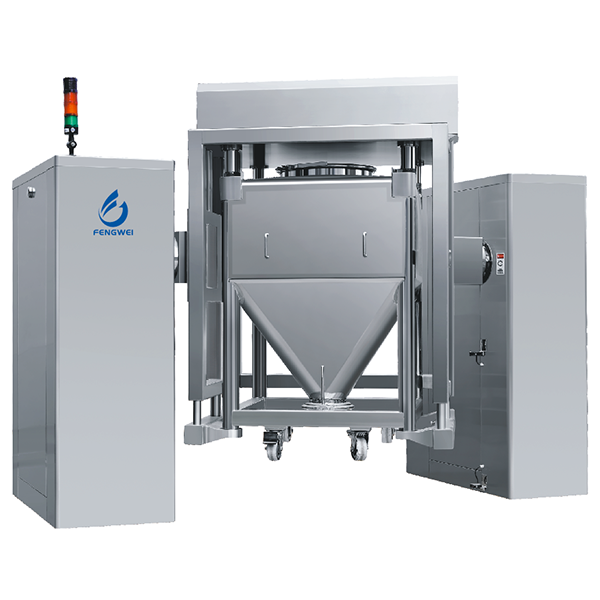
For a mobile batch-handling concept, an automatic lifting hopper mixer can be evaluated as one industrial powder mixer category within the wider material-transfer workflow. Suitability still needs confirmation against the actual formula, batch size, cleaning method, and line layout.
Compare Industrial Powder Mixer Proposals on Equal Terms
A defensible specification helps teams compare each industrial powder mixer on equal conditions. Put batch size beside the operating range, then state material properties, contact-part expectations, charging and discharge interfaces, utilities, footprint, access for cleaning, and available documentation. This makes the industrial powder mixer comparison more useful than a simple price or volume comparison.
Ask suppliers to state assumptions, exclusions, manuals, maintenance needs, drawings, and information available for qualification planning. The lowest purchase price for an industrial powder mixer may not be the lowest lifecycle burden if cleaning, inspection, or changeover is difficult. Do not treat generic certificates or unverified marketing statements as proof that an industrial powder mixer fits a specific pharmaceutical process.
Final Industrial Powder Mixer Checklist
- Define the blend purpose and downstream process requirement.
- Document batch range, powder behavior, moisture sensitivity, and ingredient proportions.
- Choose candidate industrial powder mixer designs based on verified conditions, not capacity alone.
- Plan representative trials, sampling, cleaning review, and material-flow checks.
- Confirm installation, maintenance, containment, documentation, and supplier assumptions.
The right industrial powder mixer is the one whose operating range, cleaning approach, and material-handling interfaces can be verified for the intended product. Start with the formulation and production route, then use trials and written technical clarification to select the industrial powder mixer with confidence.