 EN

How to Choose a Vacuum Conveyor for Powder Transfer
Selecting a vacuum conveyor for powder is not simply a matter of choosing a receiver and connecting a hose. The right system must suit the material, the production rhythm, the installation route, and the hygiene standard of the process. For pharmaceutical and powder-processing teams, a structured comparison helps prevent common problems such as line blockage, excessive filter maintenance, dust leakage, and difficult cleaning.
Start with the production task rather than the equipment name. Define where the powder starts, where it must arrive, how often transfers occur, and what must be protected along the way. This approach turns an equipment search into a practical specification for a vacuum conveying system.
1. Begin with the powder, not the conveying distance
The behavior of the material is the first decision point for a vacuum conveyor for powder. Record bulk density, particle size, moisture sensitivity, flowability, tendency to compact, and dustiness. A free-flowing dry powder can behave very differently from a fine, cohesive, or electrostatically charged material. If the powder bridges in a hopper, segregates during movement, or adheres to contact surfaces, those observations should shape the feeder, receiver, filter, and discharge design.
Ask production and quality teams what changes during real operation: Does the material vary by supplier or batch? Is there a risk of clumps? Must the powder be protected from ambient moisture? These questions are more useful than relying on a generic material category. Where possible, arrange a representative material trial before finalizing the configuration.
2. Map the transfer path and the required capacity
A vacuum conveyor for powder should be sized around the actual transfer duty. Document the vertical lift, horizontal distance, number of bends, feed point, discharge point, and available installation space. A short, direct route places different demands on the system than a route with multiple elevation changes or shared downstream equipment.
Capacity should also be expressed in operating terms. Consider the required kilograms per hour, batch size, refill frequency, and acceptable transfer window. Avoid treating a published maximum rate as the expected result for every powder. Real performance depends on the powder and the complete conveying path. A sensible specification leaves room for normal process variation and coordinates the conveyor cycle with the downstream mixer, mill, tablet press, or other receiving machine.
3. Match vacuum generation, receiver, and filter design
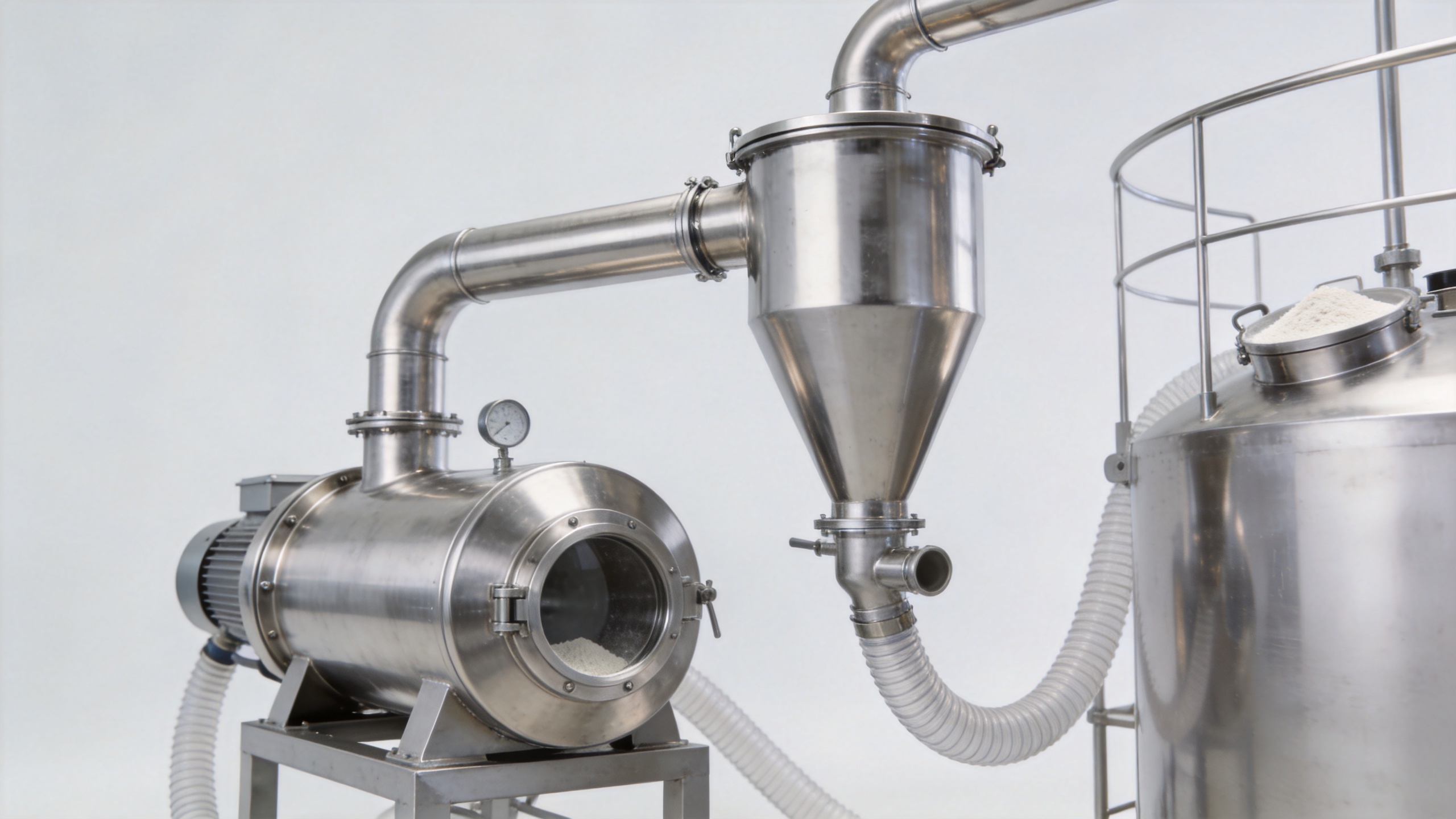
The vacuum source, receiver volume, and filtration arrangement work as a system. When comparing a vacuum conveyor for powder, ask how the receiver fills, how the filter is cleaned, and how the material is discharged. Fine powders may require closer attention to filtration and filter-cleaning intervals, while more cohesive products may require a discharge arrangement that supports reliable emptying.
Maintenance access matters as much as the nominal configuration. Operators should be able to inspect filters, seals, and contact parts without turning routine checks into a long shutdown. Clarify who will perform cleaning and changeovers, what tools are needed, and whether the layout permits safe access. A system that is easy to inspect is easier to keep consistent over time.
4. Put containment, hygiene, and cleaning requirements into the brief
For pharmaceutical powder handling, the selection of a vacuum conveyor for powder should include the process hygiene and containment requirements from the beginning. Closed transfer can help reduce exposed handling steps, but the full solution still depends on interfaces, seals, filter service practices, and the way material is introduced and discharged.
Define the cleaning expectation clearly. Is the conveyor dedicated to one material, cleaned between batches, or used for multiple products? Identify product-contact surfaces, drain or retention points, disassembly requirements, and the documentation expected by the quality team. Avoid claiming that a design is suitable for a regulated application until the required material, finish, documentation, and validation details have been confirmed.
5. Compare the complete installation, not isolated components
A reliable vacuum conveyor for powder depends on the interfaces around it. Review the pickup adapter, hose routing, receiver support, discharge connection, controls, utility availability, and access around the installation. If a system must feed a process vessel at a fixed height, the mechanical arrangement should be reviewed alongside the conveying calculation.
This is also the stage to discuss integration with the wider powder handling line. A conveyor may need to work with weighing, sieving, mixing, or milling equipment. The goal is to create a predictable transfer step rather than introduce a new bottleneck. Use the supplier discussion to confirm the physical interfaces and the information needed for commissioning.
6. Use a supplier comparison checklist
Before choosing a vacuum conveyor for powder, compare proposals using the same information set. A clear checklist makes it easier to see whether each option addresses the actual process instead of offering only a broad product description.
- Powder description and any known handling concerns
- Required capacity, batch size, and operating schedule
- Vertical lift, horizontal route, bends, and connection points
- Cleaning, changeover, containment, and maintenance expectations
- Available utilities, controls, and downstream equipment interfaces
- Trial requirements, technical documents, spare parts, and commissioning support
For an internal product reference, you can review the available ELECTRIC VACUUM FEEDER ZKS page alongside your process requirements. The final suitability should be confirmed against the real material and installation conditions rather than inferred from a product title alone.
Conclusion: turn the selection into a process decision
A suitable vacuum conveyor for powder is one that fits the powder, route, production rate, and hygiene plan as a complete system. Start with material behavior, then define the conveying duty, cleaning expectations, and surrounding interfaces. By gathering this information before requesting quotations, procurement teams can compare options on a consistent basis and move toward a system that supports stable powder transfer in daily production.