
 EN

Cone Mill vs High Shear Granulator: Understanding Different Processing Roles
A high shear granulator and a cone mill can appear in the same solid-dosage process, but they do not solve the same problem. One forms wet granules through mixing and liquid-assisted agglomeration; the other commonly conditions dried material by reducing agglomerates and controlling particle-size distribution. Treating them as interchangeable can lead to the wrong equipment discussion before material behavior, process position, and downstream needs are clear.
For pharmaceutical teams, the more useful question is not “Which machine is better?” but “Which process objective must this machine achieve?” The answer depends on whether the formulation needs wet-granule formation, post-drying sizing, gentle deagglomeration, or a combination of these stages. That distinction is especially important when a project moves from development into a validated production workflow.
The core distinction: making granules versus conditioning granules
A high shear granulator is generally used for wet granulation. Powders are mixed in a processing vessel while a binder liquid is introduced; an impeller provides intensive movement and a chopper helps control the agglomeration mechanism. The aim is to transform a powder blend into wet granules with a process endpoint that supports subsequent drying and downstream manufacture.
A cone mill, by contrast, is usually a sizing or conditioning device. It can break down soft agglomerates, help produce a more manageable particle-size distribution, and prepare dried granules for blending, lubrication, compression, encapsulation, or transfer. It does not replace the wet-granulation action of a high shear granulator when that action is required. More accurately, the two can be complementary: one establishes granule structure, while the other refines material condition at a later process node.
Where each machine fits in a typical process flow
In a wet-granulation route, a high shear granulator is often positioned after dispensing and pre-blending. Its output then moves to drying, followed by milling or sizing before final blending and tableting. The exact sequence varies by formulation and site design, but the equipment roles remain distinct.
- Blend preparation: establish an appropriate powder mixture before liquid addition.
- Wet granulation: use a high shear granulator when controlled liquid addition and intensive mixing are needed to create wet granules.
- Drying: reduce moisture to the required range using the selected drying method.
- Post-drying sizing: use a cone mill where the dried material needs deagglomeration or a controlled size distribution before downstream handling.
- Final blend and compression: confirm that flow, segregation tendency, lubrication response, and tablet requirements remain acceptable.
That process map explains why a cone mill should not be selected solely because a project mentions “granulation.” The word covers several operations. The actual decision must identify whether the immediate need is granule formation or particle conditioning.
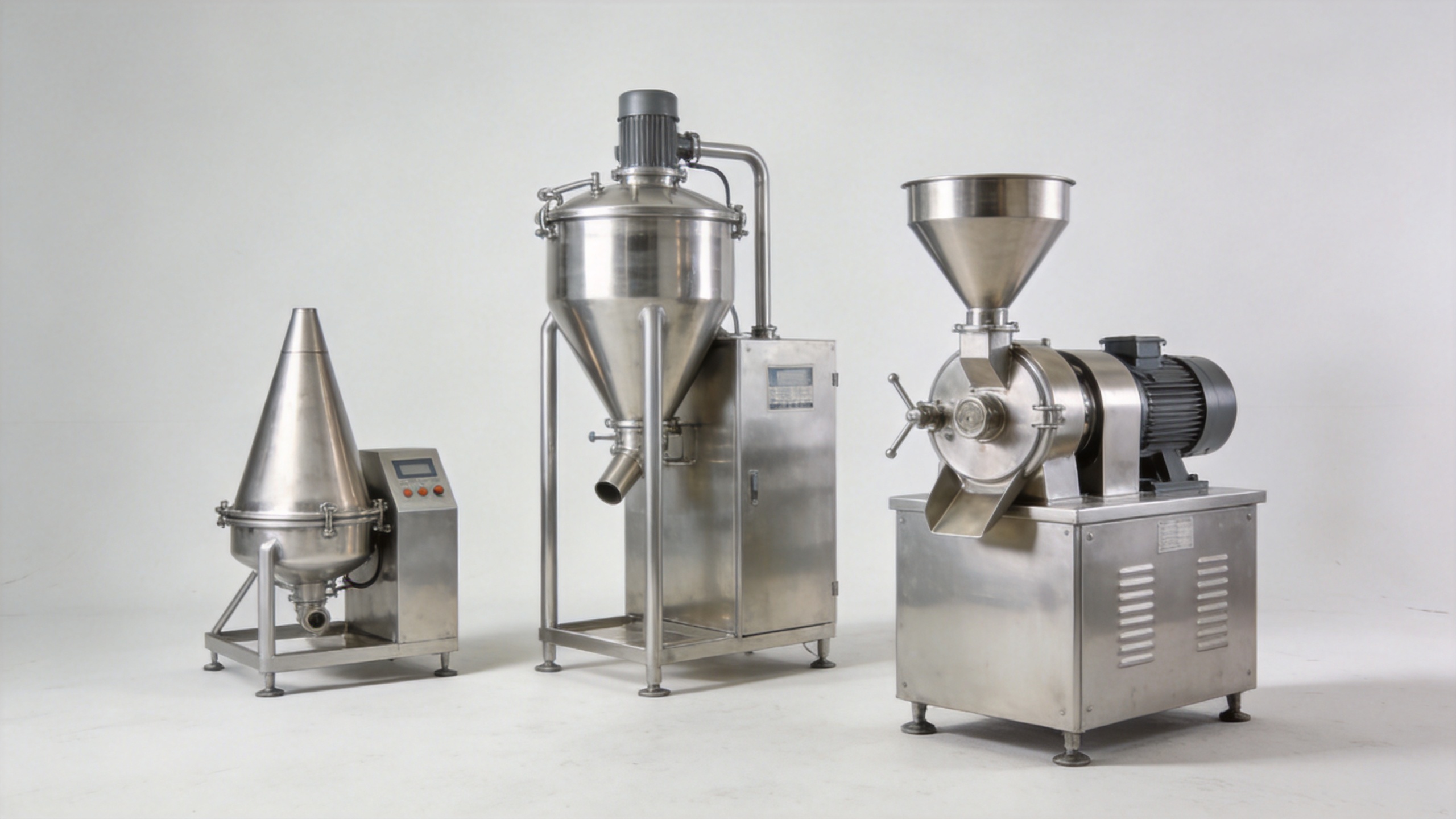
How the operating principles shape process outcomes
| Decision area | High shear granulator | Cone mill |
|---|---|---|
| Primary role | Wet mixing and granule formation | Deagglomeration and particle-size conditioning |
| Typical material state | Powder blend during liquid-assisted processing | Dried granules or other dry material requiring sizing |
| Main process levers | Impeller action, chopper action, liquid addition, process endpoint | Screen selection, rotor configuration, speed, feed behavior |
| Selection concern | Whether the formulation requires wet granulation and a controllable endpoint | Whether the material can be conditioned without unacceptable fines, heat, or particle damage |
| Relationship | May create material that later needs drying and sizing | May follow wet granulation and drying; does not duplicate wet-granule formation |
Process conditions matter more than a single machine parameter. ICH Q8(R2) frames a critical process parameter as a variable whose variability can affect a critical quality attribute. For a high shear granulator, liquid addition, mixing intensity, and endpoint logic may need to be assessed together. For a cone mill, screen aperture, rotor speed, and feed condition must be judged against the desired granule behavior and downstream performance.
Selection boundaries: when a high shear granulator is the right starting point
Start with a high shear granulator when the formulation needs wet granules to improve properties that cannot be achieved reliably through direct compression or simple dry sizing alone. Potential drivers can include poor powder flow, blend uniformity challenges, or a need to build granule structure before drying. The correct choice still depends on formulation development evidence, including the effect of liquid amount, mixing conditions, and endpoint criteria.
It is important not to promise a universal result. A high shear granulator does not automatically improve every formulation, and it is not a substitute for defining critical material attributes. Instead, it provides a controlled processing environment that should be evaluated against the intended product quality profile.
When a cone mill becomes the practical process tool
A cone mill is relevant when the process objective is to condition material rather than create wet granules. Common questions include whether dried granules contain soft agglomerates, whether a more consistent size range is needed before compression, and whether the material can pass through a selected screen without excessive fines. Usually, confirming material flow and the target particle condition before comparing equipment is more effective than choosing a model first.
For teams assessing a movable cone-milling option, the verified product page for MOVABLE CONE MILL ZLY can serve as a starting point for an equipment discussion. The product title and link identify the available equipment category; final suitability should still be confirmed against the actual material, target particle condition, cleaning expectations, and installation constraints.
A validation-oriented checklist for comparing the two roles
FDA process-validation guidance describes a lifecycle perspective: process design, process qualification, and continued process verification. That perspective is useful here because the equipment decision should be documented as part of the process logic, not treated as an isolated purchase decision.
- Define the material state: Is the feed a dry blend, wet mass, dried granule, or agglomerated intermediate?
- Define the required transformation: Do you need binder-driven granule formation, or only sizing and deagglomeration?
- Link settings to quality attributes: Identify which operating variables may affect granule size, flow, density, compression behavior, or other relevant quality attributes.
- Check downstream compatibility: Evaluate drying, transfer, blending, lubrication, compression, and cleaning requirements as one process chain.
- Plan verification: Establish development trials and qualification evidence appropriate to the product, scale, and quality system.
Conclusion: choose the role before choosing the equipment
The clearest way to compare a cone mill and a high shear granulator is to separate granule formation from particle-size conditioning. A high shear granulator is associated with wet granulation and controlled agglomeration; a cone mill is commonly used later to manage agglomerates and particle-size distribution. They may work in the same process train, but they address different technical questions.
For a reliable selection decision, document the material condition, desired transformation, relevant process parameters, and downstream acceptance criteria. This process-first approach helps pharmaceutical manufacturers avoid forcing one machine into a role that belongs to another unit operation.