
 EN

A Practical Introduction to Pharmaceutical Powder Mixing
Pharmaceutical powder mixing is often described as a simple blending step, but its real purpose is much more demanding: create a batch whose composition is suitable for the next manufacturing stage and can be assessed within the site’s quality system. A pharmaceutical powder mixer is therefore not selected by capacity alone. Material behavior, formulation ratios, batch handling, cleaning requirements, and the route to compression or filling all affect the process.
This introduction is written for teams beginning to evaluate powder mixing equipment. It is not a substitute for formulation development, validation, or regulatory advice. The practical starting point is to define the material and process conditions before comparing mixer models.
What a pharmaceutical powder mixer is meant to achieve
In practical terms, a pharmaceutical powder mixer distributes ingredients so that the blend is fit for its intended manufacturing step. In a solid-dose process, those ingredients may include an active ingredient, diluents, disintegrants, glidants, or lubricants. Visual uniformity alone is not enough: small differences in particle size, density, moisture response, or flow can change how components move through a blend.
That is why a pharmaceutical powder mixer should be considered as part of a process, not as an isolated machine. FDA material on blend and content uniformity notes the importance of controlling dose-to-dose variability in solid oral dosage forms. The appropriate sampling plan, acceptance approach, and documentation will depend on the product and the site’s quality requirements.
The material questions to answer before equipment selection
Before discussing vessel geometry or drive configuration, collect a concise material profile. This step usually gives a clearer direction than comparing a long list of specifications.
- Particle-size distribution: Wide differences can increase the likelihood of segregation during loading, blending, discharge, or transfer.
- Bulk density and component ratio: A low-dose component may require a different charging sequence or pre-blend strategy than a formulation with similarly proportioned materials.
- Flowability and cohesion: Free-flowing powders and cohesive powders do not move in the same way. A process trial should reflect the actual material condition.
- Moisture sensitivity and electrostatic behavior: These factors can influence powder adhesion, cleaning effort, and repeatability.
- Downstream requirements: Confirm whether the blend will be compressed, filled, transferred to an IBC, or held before the next step.
A practical rule is: define the powder, define the target, then define the validation questions. A larger pharmaceutical powder mixer is not automatically a better fit if the fill level, blend movement, or discharge path is unsuitable for the actual batch.
Mixing mechanisms and why geometry matters
Most pharmaceutical powder mixing systems use a combination of diffusion, convection, and shear. The appropriate balance is formulation-specific. Gentle tumbling can be appropriate for blends that need controlled movement, while more active mixing may be considered when material behavior calls for it. The point is not to label one mechanism as universally superior; it is to understand how it interacts with the formulation.
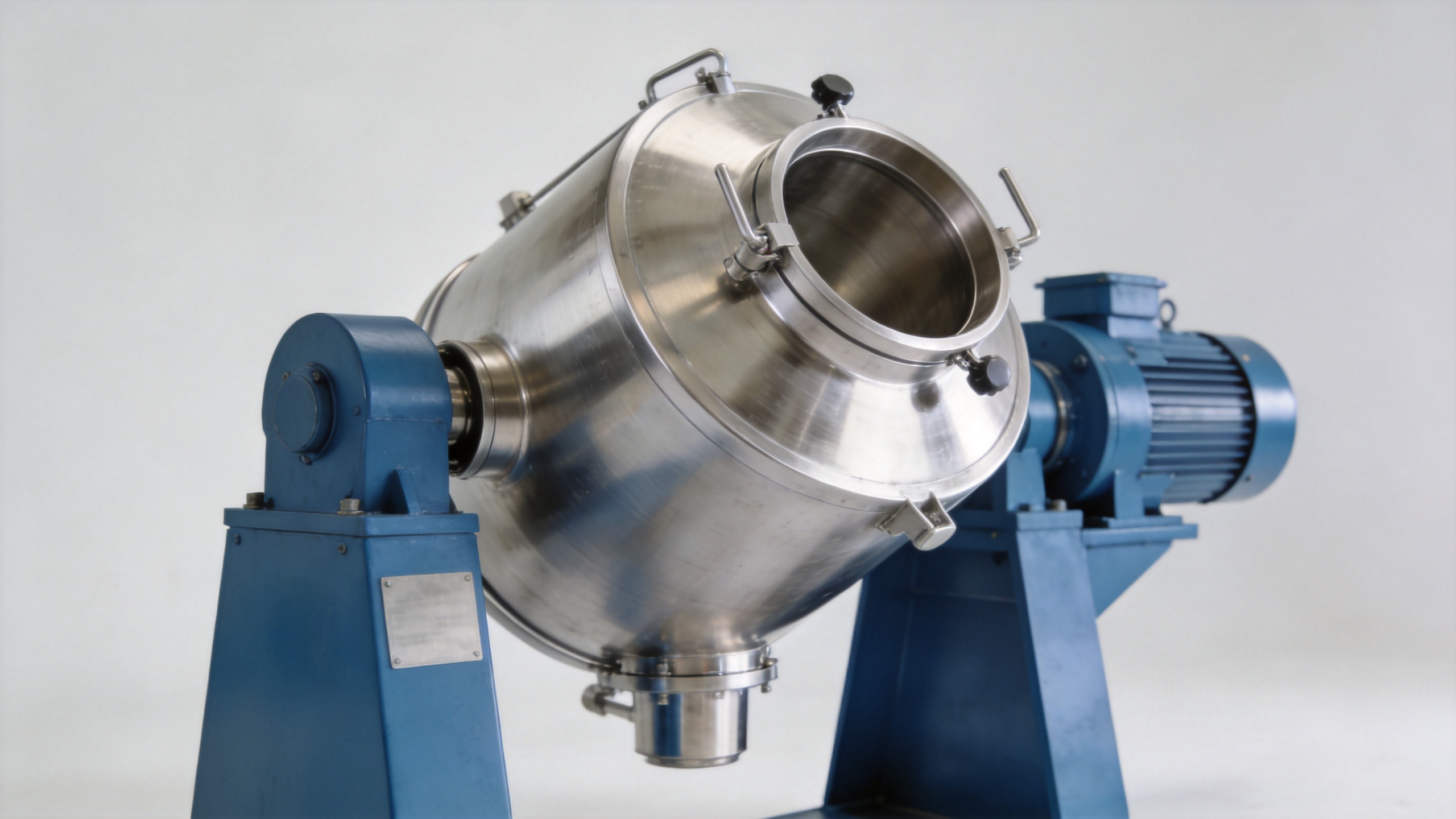
For example, a hopper-based approach can support closed handling and transfer-oriented workflows when the process design requires it. When evaluating an automatic lifting hopper mixer, ask how loading, blending, lifting, discharge, and cleaning would connect to the intended production sequence. The product name alone does not establish suitability; the project team still needs to verify material behavior and process conditions.
Blend uniformity: build a verification mindset early
The goal of a pharmaceutical powder mixer is not merely to run for a set number of minutes. Teams need a rational way to determine whether the process reaches an acceptable and repeatable blend state. In practice, this means planning development trials around the variables most likely to influence uniformity, such as fill level, blending time, rotation speed, charging order, and post-blend handling.
It is also important to distinguish mixing from later handling. A blend can appear acceptable inside the vessel yet change during discharge or transfer if components segregate. For that reason, teams should the process map should include loading, blending, discharge, transport, and the next unit operation. Under 21 CFR 211.110, manufacturers establish control procedures to monitor process output and validate processes that may cause variability; the exact implementation should be determined by the manufacturer’s quality system and applicable requirements.
Common issues that are easier to prevent than correct
- Choosing by throughput only: Capacity matters, but it does not replace consideration of working volume, fill range, powder behavior, and handling time.
- Assuming longer mixing automatically improves the blend: More time is not automatically better. Depending on the formulation, extended movement can introduce new segregation risks.
- Ignoring the discharge route: A suitable mixer can still be part of an unsuitable system if the outlet, receiving container, or transfer step disturbs the blend.
- Leaving cleaning until the final stage: Cleanability, access, changeover expectations, and documentation needs should be discussed during early equipment review.
- Using one trial as a universal answer: A result is meaningful only when its material condition and operating variables are documented well enough to be assessed and reproduced.
A practical first-pass checklist for a pharmaceutical powder mixer
- List each powder’s functional role, approximate proportion, particle characteristics, and known handling concerns.
- Map the full route: charging, mixing, discharge, transfer, and downstream processing.
- Define the intended batch range and expected operating fill range rather than relying on maximum vessel volume.
- Identify the variables to examine in a development or qualification plan, including time, speed, fill level, and charging sequence.
- Review cleaning access and the evidence required by the site’s quality procedures.
- Agree on what samples or process observations will support the blending decision.
This checklist does not prescribe a validation protocol. Instead, it helps a purchasing, engineering, and quality team ask better questions before committing to a pharmaceutical powder mixer configuration.
How to turn the first discussion into a mixer review
Use the same questions at each review gate. A pharmaceutical powder mixer proposal should describe the material inputs. A pharmaceutical powder mixer trial should record fill level and charging sequence. A pharmaceutical powder mixer review should include discharge observations. A pharmaceutical powder mixer decision should keep quality requirements visible.
| Review point | Question to document |
|---|---|
| Pharmaceutical powder mixer material fit | Which powder properties may change blend movement? |
| Pharmaceutical powder mixer batch range | What working fill range is expected? |
| Pharmaceutical powder mixer charging plan | What is the intended addition order? |
| Pharmaceutical powder mixer motion | Which movement mechanism is being assessed? |
| Pharmaceutical powder mixer timing | Which mixing-time range should the study examine? |
| Pharmaceutical powder mixer discharge | Where could segregation occur after blending? |
| Pharmaceutical powder mixer transfer | How does the blend move to the next unit operation? |
| Pharmaceutical powder mixer cleaning | What access and changeover questions must be reviewed? |
| Pharmaceutical powder mixer sampling | Which project procedure governs sampling and assessment? |
| Pharmaceutical powder mixer records | Which operating conditions need traceable documentation? |
| Pharmaceutical powder mixer scale-up | Which differences between development and production must be examined? |
| Pharmaceutical powder mixer maintenance | What inspection and service access is required? |
A pharmaceutical powder mixer shortlist becomes more useful when its assumptions are explicit. For example, a pharmaceutical powder mixer may be technically suitable at one fill level but need further evaluation at another. Likewise, a pharmaceutical powder mixer can support a transfer workflow only if the receiving process has been considered. Treat every pharmaceutical powder mixer quotation as a starting point for a documented technical discussion, not as proof of final process performance.
Moving from an introduction to a workable equipment brief
For an awareness-stage project, the next step is usually not a final equipment decision. It is a structured equipment brief that combines formulation inputs, batch needs, site layout, handling expectations, and quality requirements. That brief allows suppliers and internal stakeholders to discuss the same process problem instead of comparing isolated machine features.
Nantong FENGWEI Machinery works in material feeding, mixing, discharging, IBC system solutions, and tablet dust-removal equipment. For a powder-mixing enquiry, providing the material profile and downstream process information will support a more relevant technical discussion. Final suitability should be confirmed through project-specific assessment and appropriate testing.